

The Power of Real-Time Insight Generation for Teams and Solopreneurs
AI Management
The Power of Real-Time Insight Generation for Teams and Solopreneurs
We live in a world overflowing with dashboards, reports, charts, metrics, and notifications. Every tool wants to show you data — but very few help you actually understand what to do with it.
And that’s the real problem.
Most of us don’t need more dashboards.
We don’t need ten reporting tools.
We don’t need more analytics screens to check.
What we really need is real-time insight — the kind that surfaces automatically, explains what’s happening, and helps us act immediately.
That’s where the shift is happening:
from data collection to insight generation.
from tracking work to understanding work.
from monitoring to clarity.
And both teams and solopreneurs are feeling the impact more than ever.
Teams Are Drowning in Data (But Starving for Insight)
If you’re part of a team today, chances are your work touches half a dozen different tools:
-
a project tracker
-
a communication platform
-
a CRM
-
a file storage system
-
a time tracker
-
an analytics dashboard
They all generate information. But here’s the catch:
None of them tell you what it means.
A dashboard showing a drop in task completion doesn’t explain why.
A CRM showing lower engagement doesn’t reveal the pattern.
A project board with stalled tasks doesn’t highlight the blockage.
Teams end up manually interpreting everything — turning raw data into conclusions — and that takes time, coordination, and effort.
Worse, this manual analysis often happens too late.
Real-time insight generation solves this by shortening the distance between what’s happening and why it matters.
Solopreneurs Face the Same Problem — But With Less Time to Fix It
Solopreneurs don’t lack data either.
They lack bandwidth.
When you’re the marketer, operator, strategist, accountant, and project manager rolled into one… you don’t have time to:
-
analyze trends
-
check pipelines
-
review task progress
-
interpret analytics
-
figure out what’s slipping
-
diagnose bottlenecks
You need insights that come to you — not dashboards that wait for you to go find them.
Real-time insight generation is like having a second brain watching your business and tapping you on the shoulder when something matters.
That’s powerful.
The Magic of Real-Time Insight: It Knows Before You Ask
Real-time insight generation doesn’t wait for you to check a report.
It automatically surfaces what’s important:
-
“The last three tasks in your pipeline have been blocked for 48 hours.”
-
“You’re overcommitted this week — consider rebalancing.”
-
“Your content tasks are taking 30% longer than usual.”
-
“Your onboarding workflow has a drop-off pattern.”
It’s proactive, not reactive.
It’s like having an analyst who never sleeps, constantly scanning your work, noticing patterns, and highlighting what you’d likely miss.
This is the key difference between data and insight:
Data requires your effort; insight takes effort away.
Why This Matters for Both Teams and Individuals
The speed of modern work makes manual analysis impossible to sustain.
Real-time insight solves several silent productivity killers:
1. Bottlenecks get spotted early
Not after a deadline passes — but while something is slowing down.
2. Priorities become clearer
You always know what deserves attention next.
3. Energy is saved
You no longer burn mental calories checking ten tools.
4. Execution improves automatically
When insights guide decisions, results compound.
Whether you’re part of a team or working solo, the ability to understand your work as it happens is a game changer.
How Dyversal Brings Real-Time Insight Into Your Workflow
Dyversal isn’t just an execution engine — it’s an insight engine.
As Dyversal runs tasks, workflows, and projects, it simultaneously analyzes:
-
what’s progressing
-
what’s stuck
-
how long things take
-
where patterns form
-
what risks might arise
-
where opportunities exist
Instead of waiting for you to look at a static dashboard, Dyversal surfaces insights directly inside the Productivity Command Center — or sends them to you instantly.
This is especially powerful because Dyversal not only shows insights…
it can act on them.
A stalled task? Dyversal can move it forward.
A workflow running slowly? Dyversal can adjust it.
A missing step? Dyversal can create it.
A pattern forming? Dyversal can recommend or automate a new process.
That’s the advantage of pairing execution with insight:
your system not only understands your work — it improves it.
The Future of Work Will Be Insight-Driven, Not Data-Driven
We’re moving beyond dashboards and into a world where:
-
insights find you
-
actions follow insights
-
patterns are caught early
-
execution adapts in real-time
-
your AI becomes an operational partner
Teams gain clarity.
Solopreneurs gain time.
Everyone gains momentum.
Real-time insight generation is the quiet revolution beneath productive systems. And Dyversal is building that capability into the core of how work happens.
Not more data.
More understanding.
Not more dashboards.
More decisions.
Not more tools.
More clarity.
This is the power of real-time insight — and it’s just the beginning.


Building an Execution Engine
AI Management
Building an Execution Engine: How Dyversal Turns Human Intent into Real Output
Most people interact with AI by asking questions or requesting content. And in return, they get text, ideas, plans, summaries — things they still need to interpret and manually turn into action.
But execution?
That’s a different world.
Execution is where progress actually happens.
It’s where tasks get completed.
Where workflows run.
Where documents get created.
Where systems stay in sync.
Where ideas materialize into outcomes.
Turning human intent into real output requires more than a chatbot. It requires an Execution Engine — a system that understands goals, organizes work, and acts across tools.
This is the core of how Dyversal works. And even if you’re not technical, you can understand the design principles behind it.
Let’s break it down.
Intent → Understanding: Teaching AI to Interpret What You Mean
Most tools take your inputs literally. If you say “plan a launch,” they treat it as text — not as a real-world goal.
But human intent isn’t literal. It’s layered, broad, and full of assumptions.
Dyversal’s first job is to interpret your intent, not your wording.
If you say:
“Help me prepare for my product launch.”
You’re not asking for a paragraph.
You’re asking for a process.
That requires Dyversal to understand:
-
What a product launch involves
-
What deliverables are needed
-
What tasks come first
-
What dependencies exist
-
What tools you likely use
-
What the timeline typically looks like
This is Dyversal’s Intent Understanding Layer — it figures out what you are trying to accomplish at a holistic level, not just what you typed.
Understanding → Structure: Turning Your Goal Into a Functional Blueprint
Once Dyversal understands the goal, it needs to break it down into something executable.
This is where the structuring layer comes in.
Dyversal organizes your intent into:
-
mind maps
-
task groups
-
workflows
-
documents
-
automations
-
timelines
-
execution sequences
Why structure matters:
Raw ideas are ambiguous. Structure creates clarity.
A product launch becomes:
-
Research
-
Branding
-
Content creation
-
Landing page
-
Marketing
-
Onboarding
-
Post-launch support
Each of those becomes actionable tasks.
Each task becomes part of a workflow Dyversal can execute.
This is the bridge between “what I want” and “how it happens.”
Structure → Execution: The Heart of the Engine
This is where Dyversal becomes different from traditional AI assistants.
Most AIs generate suggestions.
Dyversal generates actions.
Once the structure is ready, the Execution Engine kicks in:
-
It creates tasks across your apps
-
It writes documents
-
It generates content
-
It updates your systems
-
It runs workflows
-
It checks progress
-
It adjusts steps based on conditions
The important part:
Dyversal doesn’t wait for you to move tasks forward — it moves them.
Execution means “things happen automatically,” whether it’s generating a draft, creating a workflow, or updating a dashboard.
Think of it like having a project manager, operations assistant, researcher, and automation engineer working together — except it’s one AI.
Execution → Insight: Closing the Loop Automatically
Once work begins, Dyversal doesn’t stop. It monitors everything that’s happening and surfaces insights automatically:
-
What’s done
-
What’s blocked
-
What needs your attention
-
What’s taking too long
-
What the next step is
-
What trends are forming
This is the Insight Layer — Dyversal’s way of keeping you informed without you needing to check five dashboards or update status manually.
It’s the opposite of traditional productivity tools, where you spend hours keeping everything updated.
Dyversal updates itself.
A Non-Technical Analogy: Dyversal Works Like a Full Kitchen Crew
Imagine you walk into a restaurant kitchen and say:
“I want a five-course dinner for my guests tonight.”
A traditional chatbot would hand you:
-
A recipe
-
A grocery list
-
A list of steps
-
A few suggestions
Helpful, sure… but you’re still cooking.
Dyversal is different.
You tell Dyversal your goal, and:
-
the chef designs the courses
-
the prep cooks chop the ingredients
-
the oven preheats
-
the team coordinates timing
-
the dishes get plated
-
everything arrives on schedule
All you did was express the intention.
The Execution Engine handled the rest.
Why This Matters: The Productivity Gap Is an Execution Problem
Most productivity tools focus on:
-
organizing
-
tagging
-
prioritizing
-
storing
-
documenting
But none of that moves work forward.
The real bottleneck in modern work isn’t planning — it’s execution.
People are drowning in tasks, workflows, content, dashboards, and tools because there is no system that actually does the work.
Dyversal fills that gap.
It turns intent into plans.
Plans into actions.
Actions into results.
It’s not about doing more — it’s about doing less and achieving more.
The Execution Engine Is the Future of AI-Driven Work
AI isn’t just becoming smarter — it’s becoming operational.
The next evolution isn’t better conversations.
It’s better output.
This is where Dyversal lives:
at the intersection of understanding, structuring, executing, and insight.
Once you experience AI that actually moves work forward, chatbots and copilots feel… incomplete.
The future isn’t conversational.
It’s actionable.
Dyversal is built for that future.

The Rise of AI Execution Agents: Beyond Chatbots and Copilots
AI Management
The Rise of AI Execution Agents: Beyond Chatbots and Copilots
For the past two years, the world has been buzzing about AI chatbots and copilots. They can write emails, answer questions, summarize documents, and generate content with remarkable ease. And sure — that’s impressive. But something interesting happened along the way:
People started asking these AIs to actually do things.
“Plan my launch.”
“Organize my workflow.”
“Run my marketing funnel.”
“Manage my week.”
And suddenly, everyone realized the same thing:
Chatbots can talk about work, but they can’t do the work.
That gap is where a new category is emerging — AI Execution Agents — and it’s changing everything about how we approach productivity.
Chatbots and Copilots Are Helpful, But Passive
ChatGPT, Claude, Gemini, and all the other conversational AIs are extraordinary for generating ideas and content. They are powerful assistants — but they remain… assistants.
They wait for instructions.
They respond.
They provide suggestions.
The limitation is built into their design:
They don’t take initiative. They don’t execute. They don’t close loops.
If you ask a chatbot to plan a project, it will outline steps.
If you ask it to break tasks down, it will give suggestions.
If you ask it to coordinate tools, it will describe how.
But in the end, you’re the one who must actually make everything happen.
You still have to paste tasks into your task manager, update documents, organize priorities, run workflows, check statuses, and manage progress.
It’s helpful — but it doesn’t reduce your workload.
It often increases it.
Enter AI Execution Agents — A Different Breed of AI
AI Execution Agents don’t stop at telling you what to do.
They do the work with you — and often for you.
They understand goals, not just questions.
They translate intent into structured plans.
They orchestrate actions across tools.
They keep tasks moving without you babysitting.
And they report back with insights instead of waiting for your next prompt.
This is the shift:
From “AI that advises” to “AI that executes.”
Think of it as the difference between a consultant and a teammate.
A consultant gives recommendations.
A teammate rolls up their sleeves and gets the job done.
Execution Agents are teammates.
Why This Change Is Happening Now
A few key forces collided at the perfect moment:
-
LLMs got better at reasoning — not just writing.
-
APIs became more accessible, allowing deeper interactions between systems.
-
Businesses realized productivity tools weren’t solving productivity problems.
-
People are overwhelmed by fragmented workflows and tool fatigue.
-
Natural language became the new interface — reducing friction dramatically.
Put these together and a question naturally emerged:
Why can’t my AI just handle this for me?
The answer is: now it can.
How Dyversal Fits Into This New Age of Execution
Dyversal wasn’t built to be another chatbot.
And it wasn’t designed to be a smarter task manager, either.
Dyversal is built as an AI Execution Engine — something fundamentally different from the conversational AIs people are used to.
Here’s what that means in real terms:
When you tell Dyversal, “Plan my product launch,” you don’t just get a list of suggestions.
You get a mind map, tasks, workflows, and actual execution steps already in motion.
When you say, “Create next week’s content flow,” you don’t get ideas —
You get drafts, schedules, tasks, and even performance insights as you go.
When you say, “Build an onboarding system for new clients,” you get a structured workflow that Dyversal can run independently.
Dyversal interprets intent.
It transforms work.
It executes.
Chatbots expand your thinking.
Dyversal expands your output.
This Is the Future: AI That Moves Work Forward
People don’t need another place to store tasks.
Or another assistant to offer more suggestions.
Or another interface that produces things they then have to manually organize.
People need AI that closes loops, not opens more of them.
This is why the rise of Execution Agents is so important — and why Dyversal is part of the wave leading this category.
We’re stepping into an era where work becomes lighter, progress becomes faster, and output becomes automatic.
Where your role shifts from managing tasks to directing outcomes.
Where your AI doesn’t just talk — it acts.
And once you experience it, you’ll never want to go back.
How Fragmented Tools Kill Productivity
AI Management
How Fragmented Tools Kill Productivity. Why We Built Dyversal as an AI Execution Engine Instead of Another Task Manager
Modern teams rely on more productivity tools than ever before—yet productivity continues to decline. Why? Because fragmented tools create productivity bottlenecks, slow down execution, and force teams into manual work cycles that steal hours each week.
Research from Asana’s Work Index shows that employees now spend over 60% of their time on “work about work”—status updates, checking tools, chasing information, and reorganizing their tasks. This fragmented workflow has become one of the biggest hidden drains on output.
Productivity isn’t broken because people are working less. It’s broken because their tools demand too much of them.
The Tool Explosion Has Created Fragmented Workflows
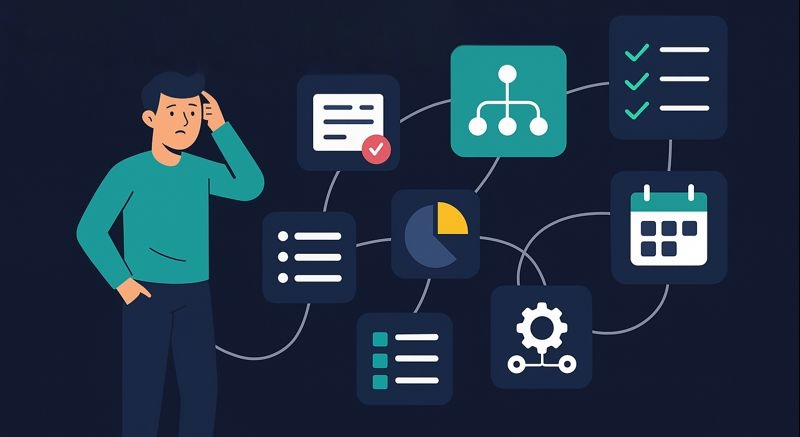
Over the past decade, teams have added tool after tool in an effort to boost efficiency. In theory, each tool solves a specific problem. In practice, they create new ones.
A typical workflow today involves:
-
Brainstorming in one tool
Planning in another
-
Storing documents elsewhere
-
Updating tasks in a project manager
-
Communicating changes in Slack
-
Running automations in a separate tool
-
Tracking data inside dashboards
This constant switching not only wastes time, it interrupts deep work. Studies show the average worker loses 20–30 minutes every time they switch applications.
This is the core issue behind fragmented tools productivity decline: more systems = more overhead.
Task Managers Don’t Actually Drive Execution
Task managers like Asana, ClickUp, or Trello are valuable—but they are fundamentally tracking systems, not execution systems.
They store tasks.
They display tasks.
They organize tasks.
But they don’t do tasks.
And so workers are stuck in a loop:
-
creating tasks
-
refining tasks
-
rewriting tasks
-
updating tasks
-
checking if tasks were done
-
reminding others
-
repeating the cycle
The result? Teams lose 3–6 hours per week just maintaining their productivity tools instead of producing meaningful work.
That’s the hidden cost of fragmentation.
Why No-Code Automations Didn’t Fix the Problem
No-code tools were supposed to simplify work, but they often add more complexity.
Most require:
-
step-by-step configuration
-
strict inputs
-
brittle triggers
-
ongoing maintenance
-
technical understanding
When something breaks, everything breaks.
When a tool changes APIs, workflows collapse.
When a team member leaves, no one knows how the automations were built.
This is the paradox of modern productivity:
You need more tools to manage the tools you already have.
The Real Problem: Tools Don’t Understand Your Intent
Fragmentation is not just about too many desktops or windows.
It’s about tools not understanding what work means.
Current systems lack:
-
context
-
memory
-
reasoning
-
decision-making
-
execution ability
They operate like individual islands.
Human beings become the bridge between them.
This slows down progress and creates artificial friction in every project.
The AI Execution Layer: A New Approach to Productivity
The answer isn’t another tool—it’s a new layer altogether.
The AI execution layer sits above your tools and unifies them through intelligence. Instead of forcing you to manually update systems, the execution layer understands your goals and carries out the work behind the scenes.
This new layer:
-
interprets natural language
-
turns ideas into structured plans
-
breaks work into tasks
-
executes actions across your apps
-
updates systems automatically
-
surfaces insights in real time
It closes the gap between planning and doing—eliminating the fragmentation that slows teams down.
How Dyversal Helps Solve Fragmented Tools Productivity Issues
Dyversal was built to directly address the productivity crisis caused by fragmented workflows.
Instead of managing dozens of apps, Dyversal acts as your AI execution agent, capable of:
-
understanding your intent
-
mapping your goal into step-by-step tasks
-
executing work across your tools
-
generating insights as progress happens
-
keeping everything synchronized
No more switching between five systems.
No more updating tasks manually.
No more productivity loss due to tool overload.
Dyversal eliminates the overhead and restores focus where it belongs—on meaningful output.
The Future Belongs to Systems That Do, Not Systems That Store
The modern productivity stack is collapsing under its own weight. Tools designed for planning and tracking can’t meet the demands of fast-moving teams.
The future belongs to platforms that:
-
understand context
-
reduce overhead
-
automate execution
-
unify workflows
-
turn ideas into outcomes
Dyversal is part of this shift—a new kind of system built to fix the productivity gap left behind by fragmented tools.