
How Fragmented Tools Kill Productivity
How Fragmented Tools Kill Productivity. Why We Built Dyversal as an AI Execution Engine Instead of Another Task Manager
Modern teams rely on more productivity tools than ever before—yet productivity continues to decline. Why? Because fragmented tools create productivity bottlenecks, slow down execution, and force teams into manual work cycles that steal hours each week.
Research from Asana’s Work Index shows that employees now spend over 60% of their time on “work about work”—status updates, checking tools, chasing information, and reorganizing their tasks. This fragmented workflow has become one of the biggest hidden drains on output.
Productivity isn’t broken because people are working less. It’s broken because their tools demand too much of them.
The Tool Explosion Has Created Fragmented Workflows
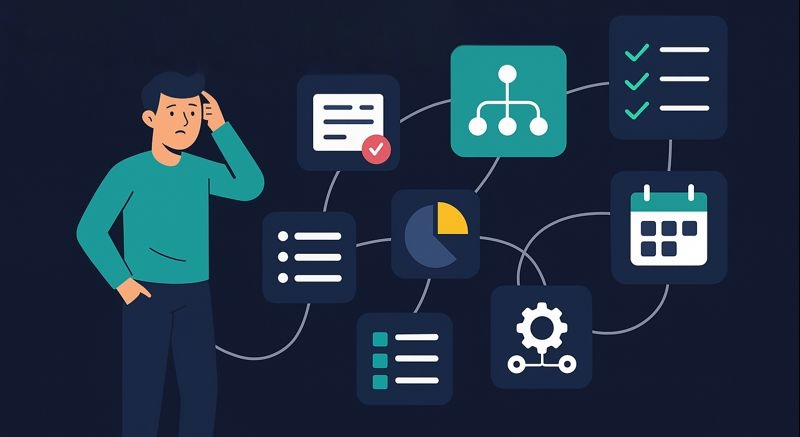
Over the past decade, teams have added tool after tool in an effort to boost efficiency. In theory, each tool solves a specific problem. In practice, they create new ones.
A typical workflow today involves:
-
Brainstorming in one tool
Planning in another
-
Storing documents elsewhere
-
Updating tasks in a project manager
-
Communicating changes in Slack
-
Running automations in a separate tool
-
Tracking data inside dashboards
This constant switching not only wastes time, it interrupts deep work. Studies show the average worker loses 20–30 minutes every time they switch applications.
This is the core issue behind fragmented tools productivity decline: more systems = more overhead.
Task Managers Don’t Actually Drive Execution
Task managers like Asana, ClickUp, or Trello are valuable—but they are fundamentally tracking systems, not execution systems.
They store tasks.
They display tasks.
They organize tasks.
But they don’t do tasks.
And so workers are stuck in a loop:
-
creating tasks
-
refining tasks
-
rewriting tasks
-
updating tasks
-
checking if tasks were done
-
reminding others
-
repeating the cycle
The result? Teams lose 3–6 hours per week just maintaining their productivity tools instead of producing meaningful work.
That’s the hidden cost of fragmentation.
Why No-Code Automations Didn’t Fix the Problem
No-code tools were supposed to simplify work, but they often add more complexity.
Most require:
-
step-by-step configuration
-
strict inputs
-
brittle triggers
-
ongoing maintenance
-
technical understanding
When something breaks, everything breaks.
When a tool changes APIs, workflows collapse.
When a team member leaves, no one knows how the automations were built.
This is the paradox of modern productivity:
You need more tools to manage the tools you already have.
The Real Problem: Tools Don’t Understand Your Intent
Fragmentation is not just about too many desktops or windows.
It’s about tools not understanding what work means.
Current systems lack:
-
context
-
memory
-
reasoning
-
decision-making
-
execution ability
They operate like individual islands.
Human beings become the bridge between them.
This slows down progress and creates artificial friction in every project.
The AI Execution Layer: A New Approach to Productivity
The answer isn’t another tool—it’s a new layer altogether.
The AI execution layer sits above your tools and unifies them through intelligence. Instead of forcing you to manually update systems, the execution layer understands your goals and carries out the work behind the scenes.
This new layer:
-
interprets natural language
-
turns ideas into structured plans
-
breaks work into tasks
-
executes actions across your apps
-
updates systems automatically
-
surfaces insights in real time
It closes the gap between planning and doing—eliminating the fragmentation that slows teams down.
How Dyversal Helps Solve Fragmented Tools Productivity Issues
Dyversal was built to directly address the productivity crisis caused by fragmented workflows.
Instead of managing dozens of apps, Dyversal acts as your AI execution agent, capable of:
-
understanding your intent
-
mapping your goal into step-by-step tasks
-
executing work across your tools
-
generating insights as progress happens
-
keeping everything synchronized
No more switching between five systems.
No more updating tasks manually.
No more productivity loss due to tool overload.
Dyversal eliminates the overhead and restores focus where it belongs—on meaningful output.
The Future Belongs to Systems That Do, Not Systems That Store
The modern productivity stack is collapsing under its own weight. Tools designed for planning and tracking can’t meet the demands of fast-moving teams.
The future belongs to platforms that:
-
understand context
-
reduce overhead
-
automate execution
-
unify workflows
-
turn ideas into outcomes
Dyversal is part of this shift—a new kind of system built to fix the productivity gap left behind by fragmented tools.